Cybersecurity
CVE-2025-60949: Census CSWeb 8.0.1 Configuration File Exposure Vulnerability
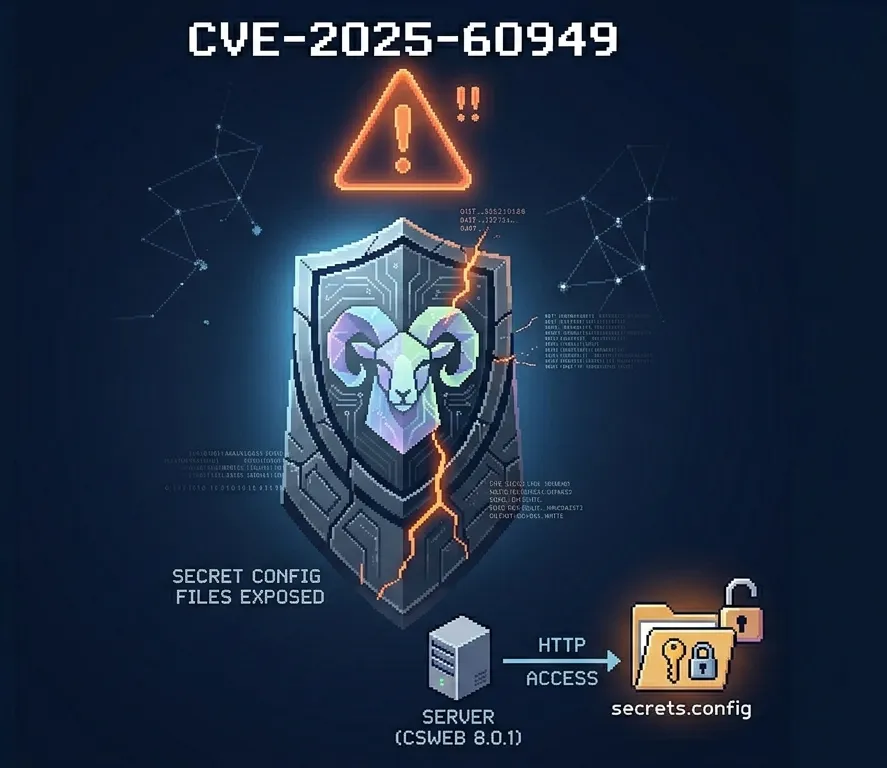
When a web application serves its own configuration files to anyone who asks, the damage extends far beyond a single leaked credential. Every database connection string, API key, and internal URL becomes a roadmap for deeper compromise. CVE-2025-60949 enables exactly this in Census CSWeb 8.0.1 — and because this software runs in national statistics offices conducting population censuses, the implications reach well beyond a typical web application vulnerability.
Census CSWeb handles sensitive demographic data, survey responses, and field worker synchronization across distributed networks. A misconfigured deployment that leaves the app/config endpoint accessible without authentication could hand a remote attacker the credentials to databases storing citizen information. The fix is straightforward, but understanding the full attack chain matters — it separates a quick patch from a proper defense.
What Is Census CSWeb and Its Role in Data Collection
CSWeb Within the CSPro Ecosystem
Census CSWeb is the web synchronization layer of CSPro (Census and Survey Processing System), a toolchain built for census and survey data management. National statistics agencies, international organizations, and research institutions deploy CSWeb to collect data from field interviewers using mobile devices. Collected data flows from CAPI applications through CSWeb into centralized databases for processing and statistical analysis.
In a production deployment, a CSWeb server typically faces the public internet. Hundreds or thousands of field workers connect over cellular networks to upload household survey records in near real-time. The server handles authentication, bidirectional data sync, conflict resolution between offline edits, and administrative functions — all driven by configuration parameters that include database credentials, encryption keys, and internal service addresses.
This internet-facing nature is not a design flaw; it is an operational requirement. Field teams need connectivity from remote locations across entire countries. But it means that any endpoint exposed without authentication is immediately accessible to the entire internet, including automated vulnerability scanners that continuously crawl for exactly this type of misconfiguration. When the exposed endpoint happens to serve the application's most sensitive operational data, the consequences can be catastrophic.
CVE-2025-60949 — Technical Analysis
The Exposed app/config Endpoint
CVE-2025-60949 is deceptively simple. Census CSWeb 8.0.1, in certain deployment configurations, does not restrict HTTP access to the app/config route. This path serves internal application configuration that should never be reachable from outside the application process. A remote, unauthenticated attacker can send a standard HTTP GET request to this endpoint and receive configuration data containing sensitive operational parameters in the response.
No authentication bypass is needed. No crafted payload. No exploit chain. The configuration data is served directly to anyone who requests it. That simplicity is precisely what makes the vulnerability so dangerous — automated scanners do not need sophistication, only a URL pattern to probe. The barrier to exploitation is effectively zero, which means the window between a vulnerable deployment going online and an attacker discovering it can be measured in hours rather than weeks.
Attack Vector and Exploitation Mechanics
The exploitation follows a pattern that penetration testers see constantly. An attacker discovers a CSWeb instance through Shodan, Censys, or subdomain enumeration against a government domain. A single GET request to /app/config returns the configuration payload. The attacker extracts database connection strings, API tokens, and encryption keys. With valid credentials in hand, pivoting into backend systems becomes straightforward.
The advisory notes that the endpoint is reachable "in some deployments," which means the exposure is configuration-dependent rather than universal. Counterintuitively, this makes the situation worse from a defensive standpoint. Teams cannot assume their installation is safe simply because it appears to work correctly. The only reliable verification is an explicit test against the endpoint or an upgrade to the patched version.
Real-World Attack Scenario: A National Census Under Threat
Consider a national statistics office conducting its decennial population census. They deploy CSWeb 8.0.1 on a cloud VM to allow thousands of field enumerators across the country to upload household data over cellular connections. The team configures the MySQL backend, enables HTTPS with a certificate from a public CA, and opens port 443 to the internet. Nobody on the deployment team verifies whether app/config is accessible without authentication in their specific server configuration.
Three weeks into the census, an automated scanner crawling for CSWeb instances reaches their server. One request to /app/config returns the MySQL connection string in cleartext: host, port, database name, username, password. That database contains names, addresses, household compositions, income brackets, and demographic identifiers for hundreds of thousands of citizens who have already been enumerated.
The attacker can exfiltrate the data directly, sell the credentials on underground markets, or establish persistence for later exploitation. The statistics office might not discover the breach for months, because accessing a legitimate HTTP endpoint generates no application-level alerts — it returns a standard 200 response indistinguishable from normal traffic in summary logs.
This scenario illustrates the core problem with information disclosure in government-deployed software: the data is inherently sensitive, the operations teams often lack dedicated security engineers, and the attack surface must be broad by operational necessity. A vulnerability that would be medium-severity in an internal business tool becomes high-severity when it exposes infrastructure handling personally identifiable information for an entire country.
What Leaked Configuration Secrets Enable
The specific secrets exposed in a configuration leak determine the blast radius. A typical CSWeb deployment configuration may contain:
- Database connection strings — Direct credentials for MySQL, SQL Server, or PostgreSQL backends storing survey data
- API keys for cloud services — Tokens for storage buckets, notification services, or data processing pipelines
- Encryption keys and salts — Used for password hashing or encrypting data at rest within the application
- Internal service URLs — Addresses of admin panels, monitoring dashboards, or microservices revealing internal network topology
- SMTP credentials — Email accounts that enable phishing campaigns impersonating the organization
- Session signing keys — Secrets that allow forging valid session tokens to impersonate any authenticated user
Each leaked secret opens a different attack vector. Database credentials lead to data exfiltration. Session signing keys enable universal account takeover across every user of the platform. Internal URLs feed the next round of reconnaissance. SMTP credentials become the foundation for targeted spear-phishing campaigns against staff members who trust internal communications.
The compounding effect is what elevates a "simple" information disclosure into a full infrastructure compromise. One configuration file rarely contains just one exploitable secret, and the combination of multiple credential types gives an attacker the flexibility to choose the path of least resistance into the organization.
Why This Mistake Keeps Happening
The Development-to-Production Gap
Configuration exposure vulnerabilities have existed since the early days of web applications. They persist because the same pattern repeats across different frameworks and teams: diagnostic endpoints that are genuinely useful during development become attack vectors in production when nobody explicitly disables them before going live.
In CSWeb 8.0.1, the phrasing "in some deployments" strongly suggests this dynamic. The default installation may be safe, but specific server configurations, reverse proxy setups, or deployment scripts leave the endpoint exposed. This conditional behavior makes the bug especially hard to catch through standard QA testing — the test environment may not reproduce the exact conditions that trigger the exposure in production.
Common patterns that produce configuration exposure across web applications:
- Shipping production builds with debug mode active and no deployment checklist to verify it is disabled
- Relying solely on the application layer for access control without reverse proxy or WAF rules as a backup layer
- Accepting framework defaults without auditing which routes are publicly reachable in the specific deployment context
- Storing secrets in flat configuration files instead of injecting them from a vault service at runtime
- Skipping security-focused deployment reviews under pressure to release on a tight schedule
The root cause across every one of these patterns is identical: security treated as a post-deployment afterthought rather than a deployment prerequisite. Until that mindset changes at the organizational level, this class of vulnerability will continue to appear in new software releases.
Comparison with Similar Configuration Exposure CVEs
CVE-2025-60949 belongs to a well-documented vulnerability class. Comparing it with historical parallels illustrates why one-off patches are insufficient — the defense must be architectural and systematic.
| CVE | Software | Exposed Resource | Impact | Root Cause |
|---|---|---|---|---|
| CVE-2025-60949 | Census CSWeb 8.0.1 | app/config endpoint | Secrets leakage | Missing auth on config route |
| CVE-2023-20873 | Spring Boot Actuator | Actuator endpoints (CF) | Security bypass, info exposure | Wildcard pattern matching flaw |
| CVE-2019-18394 | Openfire XMPP | Admin console SSRF | Internal network access | Unrestricted admin routes |
| CVE-2017-9506 | Atlassian Products | IconUriServlet | Network reconnaissance | Unrestricted URL fetch |
| CVE-2023-33246 | Apache RocketMQ | Management port | Remote code execution | No auth on mgmt API |
The Spring Boot Actuator case is the closest analogue. CVE-2023-20873 showed how a wildcard pattern matching flaw allowed attackers to bypass access controls on Cloud Foundry actuator endpoints, exposing sensitive configuration data like environment variables and heap dumps. The industry response — strengthening endpoint security and tightening default access controls — represents the secure-by-default posture every framework should adopt. CSWeb 8.1.0 alpha follows this same corrective path, but the broader lesson is that secure defaults should be the starting point of framework design, not a retroactive patch.
Remediation and Mitigation Strategies
Immediate Actions
If you run any Census CSWeb 8.0.1 deployment, take these steps without delay:
- Upgrade to CSWeb 8.1.0 alpha — This release contains the fix for CVE-2025-60949. The alpha designation is secondary to the security patch for internet-facing deployments handling sensitive data
- Block the endpoint at the reverse proxy — Configure Nginx, Apache, or IIS to return 403 for any request matching /app/config, providing immediate application-independent protection
- Rotate all exposed secrets — If your instance was ever internet-facing, assume compromise. Change database passwords, API keys, session secrets, and encryption keys across all connected systems
- Audit access logs retroactively — Search web server logs for GET requests to /app/config from external IPs. Any matches from unknown addresses warrant full incident response
- Restrict network exposure — Place CSWeb behind a VPN or limit inbound connections to IP ranges used by field teams where operationally feasible
Long-Term Architecture Hardening
Beyond the immediate patch, invest in defenses that contain damage even when application-layer vulnerabilities exist in the software stack.
Move secrets out of configuration files entirely. Use a dedicated secrets manager — HashiCorp Vault, AWS Secrets Manager, Azure Key Vault — to inject credentials at runtime. If a configuration endpoint leaks, it reveals vault references rather than usable credentials. The performance overhead is negligible for CSWeb workloads where synchronization latencies are measured in seconds rather than sub-millisecond ranges. This is one of those cases where the security benefit is enormous and the performance cost is effectively zero.
Deploy a Web Application Firewall with rules blocking known sensitive paths. Most WAF providers ship rulesets covering common configuration endpoints out of the box, and a custom rule for /app/config takes minutes to add. This layer operates independently of the application, so an application-level bug cannot bypass it.
Enforce network segmentation so the database server accepts connections only from the application server's private network interface. A leaked connection string becomes useless if the attacker cannot reach the database port from the public internet. This single architectural decision neutralizes the most dangerous consequence of CVE-2025-60949.
Defense-in-Depth: Web Server Configuration
The lesson from CVE-2025-60949 applies universally. Any web application reading sensitive configuration should be fronted by a reverse proxy that explicitly denies access to internal paths as a baseline defense layer.
location ~* ^/(app/config|\.env|\.git|web\.config|appsettings) {
    deny all;
    return 404;
}

location ~* \.(ini|conf|cfg|yaml|yml|toml|properties)$ {
    deny all;
    return 404;
}
At the application architecture level, the security model should be inverted. The default posture should be "all routes require authentication unless explicitly marked public" instead of "all routes are public unless restricted." This deny-by-default approach would have prevented CVE-2025-60949 regardless of deployment configuration, because the config endpoint would have demanded authentication from the moment it was deployed.
For secrets management specifically, treating credentials as ephemeral and automatically rotated reduces the exploitation window dramatically. Short-lived database tokens that refresh every hour mean a leaked configuration goes stale before an attacker can extract meaningful data. Cloud-managed databases increasingly support IAM-based authentication that eliminates stored passwords altogether — a pattern worth adopting wherever the infrastructure supports it.
Frequently Asked Questions
How severe is CVE-2025-60949?
The vulnerability allows unauthenticated remote access to sensitive configuration with zero exploitation complexity. For internet-facing deployments where the configuration contains database credentials, the effective CVSS score is likely 7.5 or higher. Any exposed instance should be treated as a critical finding requiring immediate action and secret rotation.
Does this affect all CSWeb 8.0.1 installations?
The advisory states the endpoint is reachable "in some deployments," indicating the exposure is configuration-dependent. However, absence of evidence is not evidence of absence. If you run 8.0.1, verify your deployment explicitly or upgrade to 8.1.0 alpha rather than assuming safety based on default behavior.
Can I mitigate without upgrading?
Blocking /app/config at the reverse proxy or firewall level prevents exploitation effectively. This is a valid workaround but not a permanent fix — any infrastructure change or proxy reconfiguration could re-expose the endpoint. Upgrading remains the definitive solution and should be prioritized.
How do I detect if my instance was already compromised?
Search web server access logs for requests to /app/config from external IP addresses. If found, treat it as confirmed credential compromise: rotate every secret in the configuration file, audit database access logs for unauthorized queries, and inspect the system for persistence mechanisms such as new database users or modified application files.
Conclusion
CVE-2025-60949 reinforces a persistent truth in application security: information disclosure vulnerabilities, despite their apparent simplicity, carry outsized consequences when they affect software handling government and population data. The immediate fix is straightforward — upgrade to CSWeb 8.1.0 alpha and block the configuration endpoint at the network layer. The deeper lesson is architectural: secrets should never reside in files reachable by HTTP, configuration endpoints should require authentication by default, and applications deployed in sensitive environments deserve the same security scrutiny applied to banking and healthcare platforms.
If your organization runs Census CSWeb or similar field data collection platforms, audit your configuration exposure today, implement a secrets management strategy, and establish a patch cadence that addresses security advisories within days rather than quarters. The cost of prevention is a fraction of what breach response demands.
References
Tags
Share this post
Subscribe
Get the latest posts delivered right to your inbox.



Leave a comment