Cybersecurity
CVE-2026-3909: Critical Out-of-Bounds Write in Chrome's Skia Engine
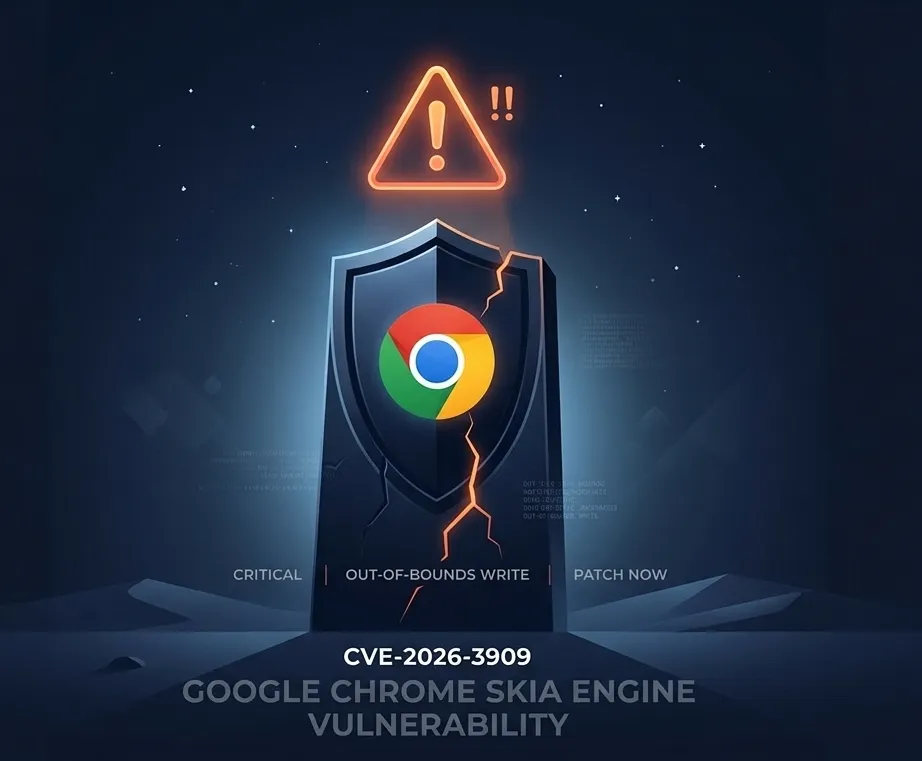
Google has released an emergency security update for Chrome, patching two zero-day vulnerabilities that are being actively exploited in the wild. Among them, CVE-2026-3909 stands out as a particularly dangerous out-of-bounds write vulnerability in Skia, Chrome's 2D graphics rendering engine. With a CVSS score of 8.8, this flaw allows remote attackers to corrupt memory and potentially achieve arbitrary code execution simply by luring a victim to a malicious webpage.
The vulnerability affects all Chrome versions prior to 146.0.7680.75 and has already been added to CISA's Known Exploited Vulnerabilities catalog, with federal agencies given until March 27, 2026 to apply the patch. Given that Chrome commands over 65% of the global browser market, the potential blast radius of this vulnerability is enormous — affecting billions of users across desktop and mobile platforms worldwide.
In this article, we dissect the technical details of CVE-2026-3909, explore how out-of-bounds write vulnerabilities work at the memory level, examine the role Skia plays in Chrome's rendering pipeline, and provide actionable guidance for end users and developers who build web applications consumed by billions of Chrome users.
What Is CVE-2026-3909?
CVE-2026-3909 is a high-severity vulnerability classified as an out-of-bounds write (CWE-787) in the Skia graphics library bundled with Google Chrome. Published on March 13, 2026, it carries a CVSS v3.1 base score of 8.8 (High).
The vulnerability allows a remote, unauthenticated attacker to trigger an out-of-bounds memory write by serving a specially crafted HTML page. When Chrome's rendering engine processes the malicious content, Skia attempts to write data beyond the boundaries of an allocated memory buffer, corrupting adjacent memory regions.
The CVSS vector breakdown reveals why this is so critical:
- Attack Vector: Network (AV:N) — exploitable remotely through the internet
- Attack Complexity: Low (AC:L) — no special conditions or race conditions needed
- Privileges Required: None (PR:N) — no authentication necessary
- User Interaction: Required (UI:R) — victim must visit the malicious page
- Impact: High confidentiality, integrity, and availability impact across all three pillars
Google has confirmed that exploits for this vulnerability exist in the wild, though specific details about the threat actors and targeted campaigns remain undisclosed to prevent further exploitation before users can patch.
A key takeaway for security teams: the low attack complexity combined with network-based exploitation and no privileges required makes this vulnerability trivially exploitable at scale. Any delay in patching increases organizational risk exponentially.
Understanding Skia: Chrome's Graphics Rendering Engine
Skia is an open-source 2D graphics library that serves as the rendering backbone for Google Chrome, Android, Flutter, and numerous other Google products. Every pixel you see rendered in Chrome — from text and images to CSS gradients and SVG animations — passes through Skia's rendering pipeline. Understanding its architecture is essential to grasping why CVE-2026-3909 is so impactful.
Why Skia Is a High-Value Attack Surface
Skia processes untrusted input from every webpage a user visits. It must handle a vast array of graphics primitives: paths, text glyphs, image decoders, shaders, and compositing operations. This combination of complexity and constant exposure to untrusted data makes it a prime target for attackers looking for reliable exploit primitives.
When a browser renders a webpage, the HTML/CSS layout engine determines what needs to be drawn, and Skia translates those instructions into actual pixel operations. A vulnerability in this layer means an attacker can craft visual content — seemingly innocent HTML and CSS — that triggers memory corruption deep within the browser's rendering pipeline.
Consider a real-world scenario: a user receives a link to what appears to be a legitimate news article. The page loads normally, displaying text and images. But embedded within the page's rendering instructions is a carefully crafted element that causes Skia to miscalculate a buffer size during a draw operation. The write overflows the allocated buffer, and the attacker gains control of adjacent memory — all without any visible indication to the user.
Skia's Architecture and Memory Management
Skia uses C++ for performance-critical rendering operations. While this provides the speed necessary for real-time graphics rendering at 60fps and beyond, it also means that memory management is manual. Unlike memory-safe languages such as Rust, C++ does not enforce bounds checking at compile time, making out-of-bounds writes possible when input validation is insufficient or when edge cases in complex rendering logic are not accounted for.
The library processes complex data structures internally, including path geometries, bitmap pixel buffers, and glyph caches. Each of these involves dynamic memory allocation, and any miscalculation in buffer sizes during rendering operations can lead to the type of out-of-bounds write exploited in CVE-2026-3909. This architectural reality is precisely why Google has been investing heavily in memory-safe rewrites and sandboxing — but legacy C++ code in Skia remains vast, and vulnerabilities like this one demonstrate the ongoing risk.
How Out-of-Bounds Write Exploits Work
An out-of-bounds write (CWE-787) occurs when a program writes data past the end — or before the beginning — of an allocated memory buffer. This is one of the most dangerous classes of memory corruption vulnerabilities because it gives attackers the ability to alter program state in controlled and predictable ways.
The Exploitation Chain
In a typical out-of-bounds write exploit targeting a browser, the attack follows a predictable chain:
- Heap Preparation (Heap Spray / Feng Shui): The attacker first manipulates the browser's heap layout by allocating and freeing objects in a specific pattern, placing target objects adjacent to the vulnerable buffer.
- Trigger the Vulnerability: The crafted HTML causes Skia to perform a write operation that exceeds the buffer boundary, overwriting adjacent heap metadata or object data.
- Control Hijack: By carefully controlling the overwritten data, the attacker can corrupt function pointers, virtual table entries, or other control flow data structures.
- Code Execution: The corrupted control flow data redirects execution to attacker-controlled code, typically shellcode placed elsewhere in memory or a ROP chain that bypasses DEP.
A practical scenario illustrates the severity: an attacker embeds a malicious SVG element in an advertisement served through a legitimate ad network. Millions of users see the ad. For each one, Chrome's Skia engine processes the SVG, triggers the out-of-bounds write, and the attacker can execute arbitrary code with the privileges of the browser process — all without any visible anomaly on the page.
Why Out-of-Bounds Writes Are Particularly Dangerous
Unlike read-only vulnerabilities that leak information, out-of-bounds writes give attackers active control over program memory. They can:
- Overwrite security-critical flags or permissions in adjacent objects
- Corrupt function pointers to redirect execution flow
- Modify object metadata to chain additional exploit primitives
- Bypass ASLR by overwriting known offsets in predictable heap layouts
This makes CVE-2026-3909 significantly more severe than a typical information disclosure bug. The write primitive is often the single most valuable capability an attacker needs to achieve full code execution in a modern browser.
CVE-2026-3910: The Companion V8 Zero-Day
Alongside CVE-2026-3909, Google patched a second zero-day: CVE-2026-3910, an inappropriate implementation vulnerability in V8, Chrome's JavaScript engine. While the two vulnerabilities target different components, their simultaneous disclosure and active exploitation suggest they may have been used together in sophisticated attack chains.
V8 handles JavaScript execution, and an inappropriate implementation flaw can allow attackers to bypass security checks or manipulate JavaScript objects in unintended ways. When combined with a Skia memory corruption vulnerability, this creates a powerful exploit chain: V8 can be used to prepare the heap layout and leak necessary addresses, while the Skia bug provides the write primitive needed for full code execution.
This pattern of multi-vulnerability exploit chains is increasingly common in modern browser attacks. Attackers rarely rely on a single bug; instead, they combine multiple vulnerabilities to bypass the layered defenses built into modern browsers, including process sandboxing, ASLR, and Control Flow Integrity (CFI).
| Attribute | CVE-2026-3909 | CVE-2026-3910 |
|---|---|---|
| Component | Skia (2D Graphics Engine) | V8 (JavaScript Engine) |
| Vulnerability Type | Out-of-Bounds Write (CWE-787) | Inappropriate Implementation |
| Severity | High (CVSS 8.8) | High |
| Attack Vector | Crafted HTML Page | Crafted HTML Page |
| Exploitation Status | Actively Exploited in the Wild | Actively Exploited in the Wild |
| Fix Version | Chrome 146.0.7680.75 | Chrome 146.0.7680.75 |
| CISA KEV | Added March 13, 2026 | Added March 13, 2026 |
Impact Assessment and Affected Systems
The scope of CVE-2026-3909 is staggering. Chrome holds approximately 65% of the global desktop browser market share and over 60% on mobile. But the impact extends well beyond Chrome itself, reaching into every corner of the Chromium ecosystem.
Chromium-Based Browsers at Risk
Because Skia is part of the Chromium open-source project, every browser built on Chromium is potentially affected:
- Microsoft Edge
- Opera
- Brave
- Vivaldi
- Samsung Internet
Each of these browsers must independently ship patches based on the Chromium fix. Vivaldi, for example, has already released its own update shortly after Google's patch. Organizations that rely on multiple Chromium-based browsers face a compounded patching burden — every browser in the fleet must be updated independently, and each vendor operates on its own release schedule.
CISA's Response and Federal Mandate
The U.S. Cybersecurity and Infrastructure Security Agency (CISA) added CVE-2026-3909 to its Known Exploited Vulnerabilities (KEV) catalog on March 13, 2026. Under Binding Operational Directive 22-01, Federal Civilian Executive Branch (FCEB) agencies must apply the fix by March 27, 2026. While this directive applies directly to federal agencies, CISA strongly recommends all organizations prioritize the patch.
The addition to the KEV catalog is significant: it signals confirmed active exploitation, not theoretical risk. Organizations that track the KEV catalog as part of their vulnerability management program should treat this as a top-priority remediation item regardless of their relationship to the federal government.
Common Developer Mistakes That Enable Memory Corruption
Understanding how out-of-bounds write vulnerabilities arise helps developers avoid introducing similar flaws in their own native code, browser extensions, or WebAssembly modules. The most common patterns behind these bugs recur across projects and languages.
Insufficient Input Validation
The most frequent cause of out-of-bounds writes is trusting input dimensions without validation. When processing graphic data, developers must verify that width and height values do not cause integer overflow when multiplied, that stride calculations account for alignment and padding requirements, and that source data length matches the declared dimensions. Skipping any of these checks opens the door to buffer overflows during rendering operations.
Integer Overflow in Size Calculations
A classic vulnerability pattern: size = width * height * bytes_per_pixel. If width and height are attacker-controlled and large enough, the multiplication overflows, producing a small value. A small buffer is allocated based on the overflowed result, but the subsequent write loops use the original (large) dimensions, causing a massive out-of-bounds write. This exact pattern has been responsible for dozens of browser CVEs over the past decade and remains one of the most reliable exploit primitives attackers target.
Missing Bounds Checks in Loop Operations
When iterating over pixel data or path coordinates, every write operation must verify the target index falls within the allocated buffer. Omitting these checks — often justified for performance reasons — is exactly the kind of shortcut that creates vulnerabilities like CVE-2026-3909. The performance gain from skipping a single bounds check is negligible in modern CPUs with branch prediction, but the security cost can be catastrophic.
Mitigation and Remediation Strategies
Immediate Actions
For end users and IT administrators, the remediation path is straightforward:
- Update Chrome to version 146.0.7680.75 or later immediately
- Verify the update by navigating to
chrome://settings/help - Restart the browser — the patch is not active until the browser process is fully restarted
- Enable automatic updates if not already configured to reduce future exposure windows
Enterprise Deployment Considerations
Organizations managing Chrome at scale face additional complexity. Group Policy or MDM configurations must be updated to enforce the minimum browser version. Network-level protections such as web application firewalls and IDS/IPS should be updated with detection signatures for known exploitation patterns. Most critically, all Chromium-based browsers deployed in the environment must be inventoried and patched independently — Chrome, Edge, Brave, and any other Chromium derivative each require their own update cycle.
Scalability Considerations for Embedded Chromium
Developers who embed Chromium via CEF (Chromium Embedded Framework) or Electron must update their embedded Chromium version and ship a new application release. This is particularly critical because embedded browsers are not covered by Chrome's automatic update mechanism. Applications built on older Chromium versions remain vulnerable indefinitely until the developer ships an update, creating a long-tail exposure window that attackers actively target in supply chain campaigns.
For organizations running Chrome in kiosk mode, digital signage, or embedded applications, the update process requires staged rollouts and regression testing to ensure application-specific rendering is not affected. Plan for a browser restart across all managed endpoints and validate that business-critical web applications render correctly after the update.
Frequently Asked Questions
What is CVE-2026-3909?
CVE-2026-3909 is a high-severity out-of-bounds write vulnerability (CVSS 8.8) in the Skia graphics engine used by Google Chrome. It allows remote attackers to corrupt memory and potentially execute arbitrary code by serving a specially crafted HTML page. The vulnerability affects all Chrome versions prior to 146.0.7680.75 and is actively exploited in the wild.
Is CVE-2026-3909 being actively exploited?
Yes. Google has confirmed that exploits exist in the wild, though details about specific campaigns have not been disclosed. CISA added the vulnerability to its Known Exploited Vulnerabilities catalog on March 13, 2026, requiring federal agencies to patch by March 27, 2026.
Does this vulnerability affect browsers other than Chrome?
Yes. Any browser built on the Chromium engine — including Microsoft Edge, Opera, Brave, Vivaldi, and Samsung Internet — uses Skia and may be affected until each vendor independently ships a patched version based on the upstream Chromium fix.
How can I verify that my Chrome browser is patched?
Navigate to chrome://settings/help in your browser. Chrome will display the current version number and automatically check for available updates. You need version 146.0.7680.75 or later. After the update downloads, you must restart the browser for the patch to take effect.
Can a website exploit this vulnerability without my knowledge?
Yes. The vulnerability requires only that the user navigate to a page containing the malicious rendering instructions. No additional interaction — no clicks, downloads, or permission grants — is needed beyond visiting the site. The exploit operates silently through Chrome's rendering pipeline without any visible indication to the user.
Conclusion
CVE-2026-3909 is a stark reminder that the browser remains one of the most critical and exposed pieces of software on any system. A single vulnerability in a graphics rendering library can give attackers full code execution through nothing more than a webpage visit — no downloads, no permission prompts, no user interaction beyond clicking a link.
The combination of active exploitation, a CVSS score of 8.8, and the massive install base of Chromium-based browsers makes this patch a top-priority remediation item. Whether you are an individual user, an enterprise administrator managing thousands of endpoints, or a developer embedding Chromium in your applications, updating immediately is non-negotiable.
Stay ahead of emerging threats by keeping your browser updated, monitoring CISA's KEV catalog for new additions, and building vulnerability management workflows that can respond to zero-day disclosures within hours, not days. Subscribe to our cybersecurity feed to receive real-time analysis of critical vulnerabilities that affect the software development ecosystem.
Tags
Share this post
Subscribe
Get the latest posts delivered right to your inbox.


Leave a comment