Cybersecurity
ImageMagick Sixel Encoder Stack Buffer Overflow: CVE-2026-32259 Explained
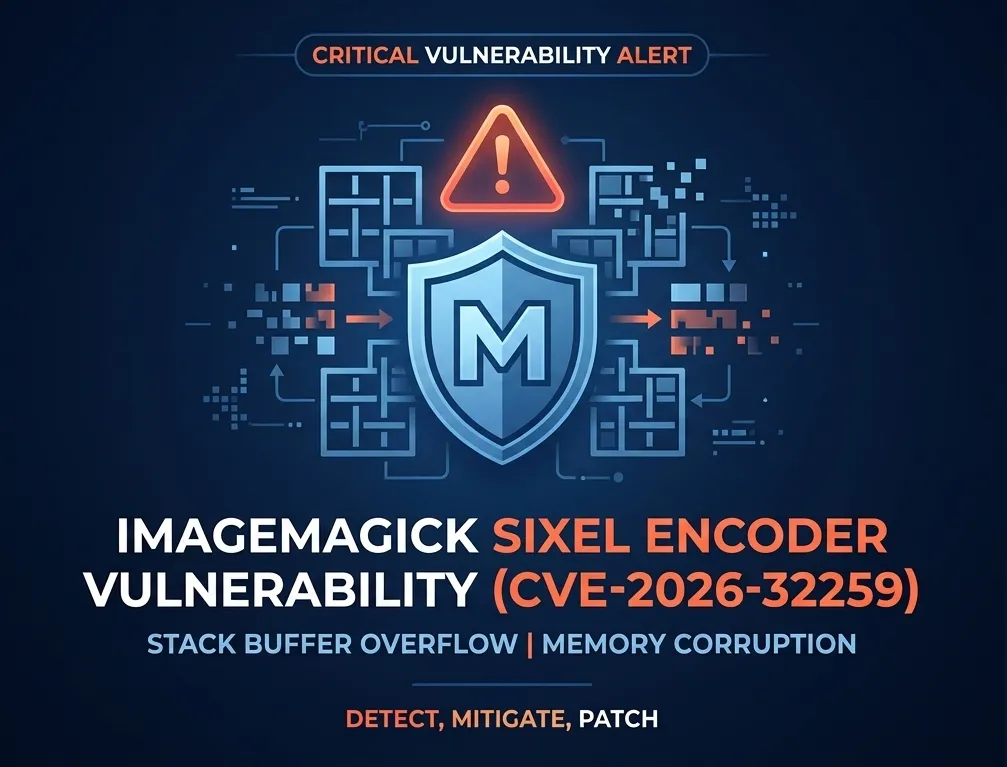
ImageMagick powers countless image processing pipelines across the globe, from small web applications to massive enterprise content delivery networks. Its versatility in handling over 200 image formats makes it a default choice for developers who need to convert, resize, or manipulate images programmatically. However, that same breadth of format support creates a sprawling attack surface that security teams must vigilantly monitor.
On March 12, 2026, a new vulnerability was disclosed under CVE-2026-32259: a stack-based buffer overflow in the sixel encoder triggered when a memory allocation fails. While its CVSS score of 6.7 classifies it as moderate, the potential consequences — stack corruption, denial of service, and in worst-case scenarios, arbitrary code execution — demand immediate attention from any team running ImageMagick in production.
This vulnerability affects all ImageMagick versions prior to 7.1.2-16 (for the 7.x branch) and 6.9.13-41 (for the legacy 6.x branch). In this article, we dissect the technical mechanics behind CVE-2026-32259, understand why it matters for real-world infrastructure, and walk through concrete steps to detect and remediate it before attackers can leverage it.
What Is ImageMagick and Why Its Security Matters
ImageMagick is a free and open-source software suite designed to create, edit, compose, and convert bitmap images. Originally released in 1990, it has become one of the most widely deployed image processing libraries in the world. Its command-line tools and programming language bindings — spanning C, C++, Perl, Python, Ruby, PHP, Java, and more — are embedded in production systems everywhere.
Common use cases include:
- Web application backends that resize user-uploaded images on the fly
- Content management systems that generate thumbnails and responsive image variants
- CI/CD pipelines that optimize image assets before deployment
- Scientific applications processing medical imaging or satellite data
- Print production workflows converting between dozens of formats
The library supports over 200 image formats, including PNG, JPEG, GIF, TIFF, WebP, SVG, PDF, and less common formats like SIXEL, MNG, and DPX. This breadth is both its greatest strength and its most significant security liability. Each format encoder and decoder is effectively an independent parser that must handle malformed or adversarial input gracefully — and history shows that many do not.
ImageMagick has been the subject of numerous high-profile vulnerabilities. The infamous ImageTragick (CVE-2016-3714) allowed remote code execution through crafted image files, affecting thousands of websites that processed user uploads. More recently, a wave of CVEs in early 2026 highlighted ongoing challenges in memory safety across multiple encoders and decoders.
The attack surface of ImageMagick is proportional to the number of codecs it compiles. Each encoder and decoder is effectively an independent parser that must handle malformed input gracefully. If your infrastructure touches ImageMagick, you must treat every CVE disclosure as a priority event, regardless of the published severity score.
Understanding the Sixel Format and Its Encoder
Sixel (short for "six pixels") is a bitmap graphics format originally developed by Digital Equipment Corporation (DEC) for its line of terminals in the 1980s. Each sixel character encodes a column of six vertical pixels, allowing text-based terminals to render rudimentary graphics inline with text output. While it may seem archaic, sixel has experienced a resurgence in modern terminal emulators like mlterm, xterm (with sixel support enabled), foot, and iTerm2.
How Sixel Encoding Works
ImageMagick includes both a sixel decoder (for reading sixel images) and a sixel encoder (for writing them). The encoder converts internal pixel representations into the sixel character stream, handling color palette assignment, pixel grouping, and the specific escape sequences that terminals expect.
The encoding process follows these steps:
- Pixel data is read from ImageMagick's internal image representation
- Colors are quantized to a palette, typically supporting up to 256 entries
- Pixel columns are grouped into sixel rows (six pixels high each)
- Each row is encoded as a sequence of characters with color selection commands
- The final stream is wrapped in DCS (Device Control String) escape sequences
During this process, the encoder allocates buffers — some on the stack — for intermediate data. These buffers are sized based on the expected image dimensions and color depth. When the system is under memory pressure and an allocation fails, the encoder must handle that failure gracefully or risk overwriting adjacent memory on the stack.
Consider a containerized microservice running with strict memory limits (e.g., 256 MB via cgroups). Under heavy load with concurrent image conversions, memory allocation failures become significantly more likely. This makes the vulnerability exploitable under realistic production conditions, not just in contrived laboratory scenarios.
CVE-2026-32259: Anatomy of a Stack Buffer Overflow
The Vulnerability Mechanism
CVE-2026-32259 is classified as CWE-121: Stack-based Buffer Overflow. The root cause lies in how the sixel encoder handles a failed memory allocation during the encoding process. When malloc or a similar allocator returns NULL due to insufficient available memory, the encoder does not properly abort or resize its operations. Instead, it continues writing pixel data into a stack-allocated buffer using size calculations derived from the expected (but never actually allocated) memory region.
The result is a classic stack buffer overflow: the encoder writes past the end of the legitimate buffer, corrupting adjacent stack frames. Depending on what lies beyond the buffer — saved frame pointers, return addresses, or other local variables — the consequences range from a simple crash to full control-flow hijacking.
CVSS Breakdown and Severity Analysis
The vulnerability carries a CVSS v3.1 score of 6.7 (Moderate) with the following vector:
- Attack Vector: Local — the attacker needs to provide a crafted image file to a local ImageMagick process
- Attack Complexity: High — exploitation requires triggering a memory allocation failure at precisely the right moment
- Privileges Required: None — no special privileges are needed beyond the ability to submit an image
- User Interaction: None — no user action is required beyond the application processing the image
- Confidentiality Impact: None — the vulnerability does not directly leak data
- Integrity Impact: High — stack corruption can alter program execution flow
- Availability Impact: High — the most likely outcome is a process crash (denial of service)
Do not let the "Moderate" label create a false sense of security. The "High" attack complexity reflects the difficulty of reliably controlling memory pressure, but in environments with constrained resources — containers, serverless functions, shared hosting — this complexity drops significantly. An attacker who can upload images and knows the target runs in a memory-constrained environment has a realistic path to denial of service, and potentially more.
The critical takeaway here is that CVSS scores represent theoretical exploitability in a generic environment. Your actual risk depends heavily on your deployment model. A monolithic application running on a dedicated 64 GB server faces a very different threat profile from a containerized microservice running in a 256 MB pod.
Real-World Impact: Where ImageMagick Lives in Production
A Typical Image Processing Architecture
Consider a common e-commerce platform architecture where users upload product images. The flow typically follows this sequence:
- User uploads an image through the web frontend
- The API gateway routes the upload to an image processing microservice
- The microservice invokes ImageMagick to generate multiple thumbnail sizes, optimize quality, and convert to WebP
- Processed images are stored in object storage (S3, Azure Blob, GCS)
- A CDN serves the final images to end users
In this architecture, the image processing microservice is the critical attack surface. If it runs in a Kubernetes pod with memory limits (which it should, for resource fairness), the pod is inherently susceptible to memory allocation failures. A malicious actor who uploads a carefully crafted image designed to maximize memory consumption during sixel encoding could trigger CVE-2026-32259 and crash the processing pod repeatedly, creating a sustained denial of service.
At scale, this is not just a single pod crashing. If horizontal pod autoscaling (HPA) is configured aggressively, repeated crashes can cascade into cluster-wide resource exhaustion as Kubernetes continuously spins up replacement pods that immediately crash again. The blast radius extends far beyond a single image conversion.
Scalability and Performance Considerations
Patching ImageMagick in production requires careful coordination. In large deployments, the upgrade path involves rebuilding container images, running regression tests on image processing outputs (since encoder changes can subtly affect output quality), and performing a rolling deployment. Teams should allocate time for visual regression testing — even security patches can inadvertently change encoding behavior in edge cases.
For organizations that compile ImageMagick from source with custom ./configure flags, the patching process also requires verifying that the build configuration disables unnecessary codecs. If your application never produces sixel output, you can mitigate this specific CVE by compiling without sixel support entirely using --without-sixel.
How to Detect and Remediate CVE-2026-32259
Checking Your ImageMagick Version
Run the following command to determine your installed version:
magick --version
# or for legacy installations:
convert --version
If the reported version is lower than 7.1.2-16 (for the 7.x series) or 6.9.13-41 (for the 6.x series), your installation is vulnerable.
For automated detection in CI/CD pipelines, you can incorporate a version check:
#!/bin/bash
VERSION=$(magick --version | head -1 | grep -oP 'ImageMagick \K[0-9.-]+')
echo "Detected ImageMagick version: $VERSION"
# Compare against patched versions and fail the build if vulnerable
Patching Strategy
The recommended remediation steps, in order of preference:
- Update to the patched version — Upgrade to 7.1.2-16 or 6.9.13-41 immediately
- Disable the sixel encoder — If you do not need sixel output, recompile with
--without-sixelor use the policy.xml file to block sixel encoding - Restrict resource access — Use ImageMagick's
policy.xmlto limit memory usage, image dimensions, and allowed formats - Isolate the process — Run ImageMagick in a sandboxed environment with strict seccomp profiles and memory limits
A restrictive policy.xml configuration as a defense-in-depth measure:
<policymap>
  <policy domain="resource" name="memory" value="256MiB"/>
  <policy domain="resource" name="map" value="512MiB"/>
  <policy domain="resource" name="width" value="10000"/>
  <policy domain="resource" name="height" value="10000"/>
  <policy domain="coder" rights="none" pattern="SIXEL"/>
</policymap>
Common Mistakes Developers Make with ImageMagick Security
Security incidents involving ImageMagick frequently stem from the same recurring antipatterns. Recognizing them helps you avoid repeating history:
- Running without policy.xml restrictions — The default ImageMagick configuration places no limits on resource consumption or enabled codecs. Every production deployment should ship with a restrictive policy that whitelists only the formats and resource levels actually needed.
- Processing uploads synchronously in the request path — Performing image conversion inside an HTTP request handler means a malicious image can block or crash the web server directly. Always offload image processing to an asynchronous worker queue.
- Ignoring minor version updates — Many teams treat ImageMagick as "infrastructure" that does not need regular updates. The library receives frequent security patches, and falling behind by even a few minor versions can leave you exposed to multiple known CVEs simultaneously.
- Trusting file extensions for format detection — ImageMagick determines the format by examining file contents, not extensions. A file named
photo.jpgcould contain sixel data that triggers the vulnerable encoder path. Input validation at the application layer is not sufficient; policy-level codec restrictions are essential. - Running ImageMagick as root — If the process is compromised through a buffer overflow that achieves code execution, running as root gives the attacker full system access. Always run ImageMagick under a dedicated, unprivileged user account.
Comparison: Recent ImageMagick Vulnerabilities (2026)
CVE-2026-32259 is part of a larger wave of vulnerabilities disclosed in ImageMagick during early 2026. Understanding how it compares to related CVEs helps prioritize your patching efforts:
| CVE | Component | Type | CVSS | Fixed In |
|---|---|---|---|---|
| CVE-2026-32259 | Sixel Encoder | Stack Buffer Overflow | 6.7 (Moderate) | 7.1.2-16 / 6.9.13-41 |
| CVE-2026-30929 | MagnifyImage | Stack Buffer Overflow | 7.7 (High) | 7.1.2-16 / 6.9.13-41 |
| CVE-2026-25970 | Sixel Decoder | Integer Overflow | 5.1 (Moderate) | 7.1.2-15 / 6.9.13-40 |
| CVE-2026-30937 | XWD Encoder | Heap Buffer Overflow | 6.8 (Moderate) | 7.1.2-16 / 6.9.13-41 |
| CVE-2026-30883 | PNG Encoder | Heap Buffer Overflow | 6.8 (Moderate) | 7.1.2-16 / 6.9.13-41 |
The pattern is clear: multiple encoders and decoders share similar classes of vulnerabilities — buffer overflows caused by integer arithmetic errors or missing boundary checks. This reinforces the importance of updating to the latest patched version rather than cherry-picking fixes for individual CVEs, as the root causes often span multiple codecs.
Frequently Asked Questions
Can CVE-2026-32259 be exploited remotely?
Not directly. The attack vector is classified as Local, meaning the attacker needs to provide a crafted image file to a local ImageMagick process. However, in web applications that accept image uploads and process them with ImageMagick, a remote user can effectively trigger the vulnerability by uploading a malicious file. The "local" classification refers to the execution context, not the delivery mechanism.
Does this vulnerability affect applications that only read images with ImageMagick?
No. CVE-2026-32259 specifically affects the sixel encoder (the write path). If your application only uses ImageMagick to decode or read images and never converts output to sixel format, you are not directly vulnerable to this specific CVE. However, you should still update because the same release fixes multiple other vulnerabilities in decoders.
Is the sixel format commonly used in modern applications?
Sixel has a niche but growing user base among developers who work extensively in terminal environments. Terminal-based image viewers, CLI tools that display previews, and certain scientific visualization pipelines use sixel output. Most mainstream web applications do not produce sixel output, but if your ImageMagick policy does not explicitly block it, the encoder code is still reachable.
How can I verify that my patch was applied correctly?
After updating, verify the version number with magick --version. For additional assurance, you can run ImageMagick's built-in test suite or attempt to convert a standard test image to sixel format and confirm it completes without errors: magick test.png sixel:output.six. If the process completes cleanly, the patched encoder is functioning correctly.
Should I migrate away from ImageMagick entirely?
That depends on your requirements. Alternatives like libvips, Sharp (Node.js), or Pillow (Python) offer smaller attack surfaces because they support fewer formats. However, if you need ImageMagick's breadth of format support, the better strategy is to maintain it with strict policy.xml restrictions, regular updates, and process isolation rather than migrating to a less capable tool.
Conclusion
CVE-2026-32259 is a reminder that even well-established open-source tools require continuous security vigilance. The stack buffer overflow in ImageMagick's sixel encoder may carry a moderate CVSS score, but in memory-constrained production environments — containers, serverless, shared hosting — the exploitation path is more realistic than the score suggests.
The fix is straightforward: update to ImageMagick 7.1.2-16 or 6.9.13-41. Pair that with a restrictive policy.xml, process isolation, and a commitment to tracking ImageMagick security advisories going forward. Your image processing pipeline is only as secure as its least-maintained dependency.
If you found this analysis useful, explore our other cybersecurity articles for in-depth coverage of vulnerabilities affecting the software you rely on every day.
Tags
Share this post
Subscribe
Get the latest posts delivered right to your inbox.
Leave a comment