Artificial Intelligence
AI agent protocols: MCP, A2A and AG-UI, what each one connects
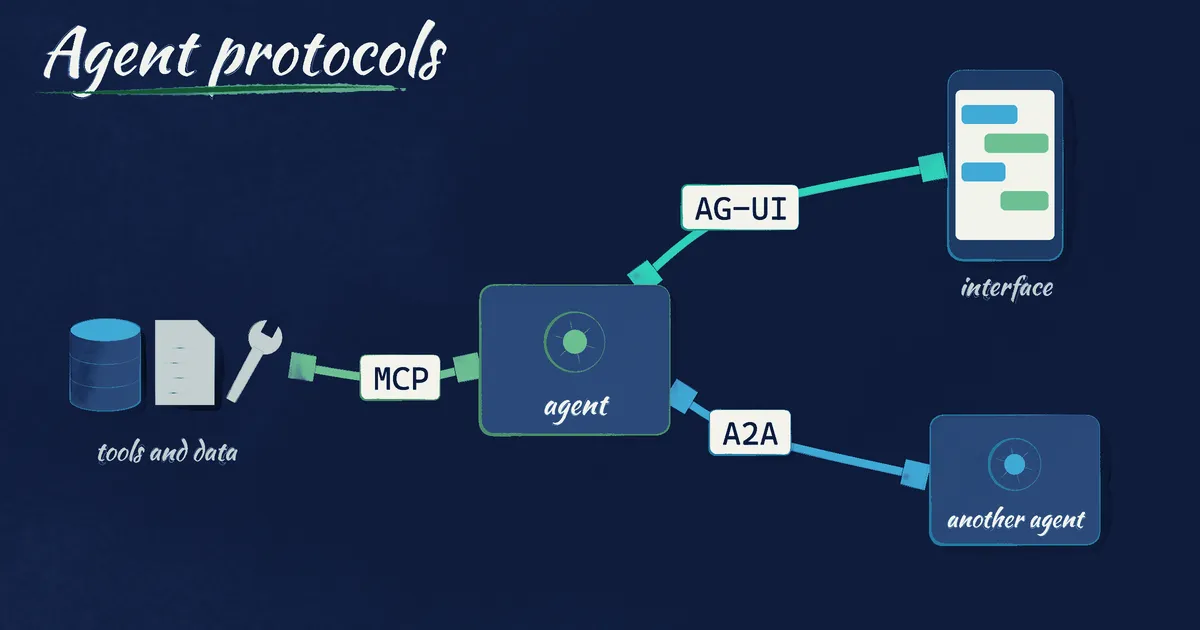
An agent protocol is a public agreement on how an AI agent asks another system for something and how it gets the answer back, so that every pair of systems does not need its own hand-built integration. An agent, a program that uses a language model to decide which steps to take and then carries them out, talks to three parties: its tools and data, other agents, and the person using it through an application. Each of those conversations now has an open protocol: MCP for tools, AG-UI toward the application and A2A between agents.
Why a protocol was needed
Anthropic named the problem when it introduced MCP on November 25, 2024: every new data source required its own custom implementation. MCP borrows from the Language Server Protocol, which standardized how to add support for a programming language across all development tools at once. Google raised the same point for agents when it announced A2A on April 9, 2025: agents should be able to work together even when a different vendor built them, or built them on a different framework.
The problem is the same at every layer: without a standard, each new connection is coded separately. Who created each one and where it lives today:
| Who the agent talks to | Protocol | Created by | Where it lives today |
|---|---|---|---|
| Tools and data | MCP (Model Context Protocol) | Anthropic, 2024 | Agentic AI Foundation, under the Linux Foundation |
| Other agents | A2A (Agent2Agent) | Google, 2025 | Agentic AI Foundation, under the Linux Foundation |
| The person's application | AG-UI (Agent-User Interaction) | Born at CopilotKit | ag-ui-protocol repository, MIT license |
MCP: the agent and its tools and data
MCP connects an AI application with services that give it context and capabilities. Messages travel as JSON-RPC 2.0, a standard remote call format written in JSON, between three roles:
- Host: the AI application that opens the connections.
- Client: the connector, inside the host, that talks to one server.
- Server: the service that offers the context and capabilities.
A server can offer any of three kinds of things: resources, which are data for the person or the model; prompts, which are templated messages and workflows for the person; and tools, which are functions the model decides to call and the server runs. Agentic RAG, where the model decides when to search, is one example of an agent calling tools. MCP is the inner layer: which data the agent reads and which functions it can run.
There are two standard transports. With stdio, the client launches the server as a local process and they talk over standard input and output, one message per line. With Streamable HTTP, each message is a POST to a single server endpoint. In the current version the server does not start requests: the client asks and the server answers.
What changed in version 2026-07-28
MCP names each version after the date of its last backwards-incompatible change, and the current one is 2026-07-28. That version removed the opening handshake initialize and the sessions carried in the Mcp-Session-Id header: MCP became stateless, and every request carries its protocol version and the client's capabilities. In exchange, every server must implement server/discover, the call that advertises its versions, capabilities and identity. If a server needs to remember something between calls, it returns an identifier that the model passes as an argument in the next call. That identifier does not authenticate: the server must check on every call that it belongs to the caller.
A2A: one agent with another
A2A covers the conversation between agents that may come from different vendors. To A2A, the other agent is a closed box: it takes a task and returns a result without exposing its internal state, memory or tools. Its building blocks are:
- Agent Card: the agent's business card, listing what it can do and the authentication it requires. Its standard location is
/.well-known/agent-card.jsonon the agent's domain. - Task: the unit of work, which has a state.
- Message and Part: what the agents say to each other and the parts of each message.
- Artifact: what the task produces.
A2A travels in three ways: JSON-RPC 2.0 over HTTP with Server-Sent Events (SSE, a stream of events the server sends over HTTP), gRPC (a remote call system over HTTP/2) and HTTP/REST. The current version is 1.0, released on March 12, 2026, and its announcement warns that it brings breaking changes in the interaction protocol compared with 0.3.
ACP (Agent Communication Protocol), which IBM Research launched in March 2025, is no longer a third option between agents: it merged with A2A on August 29, 2025, and its team stopped active development to contribute to A2A instead.
How they fit together
The official A2A guide on MCP gives two examples: a customer service agent that delegates an inquiry to a billing agent, and a travel agent that coordinates with flight, hotel and activity agents. The diagram follows the first one step by step; the tools on each side are an assumed example.
The customer service agent uses MCP to read its customer database, and the billing agent uses MCP to reach its own. Only the task travels between them, over A2A. The appendix of the A2A specification describes the same split: the agent that receives the task may use MCP to talk to the tools, APIs or data sources it needs to complete it.
Who authorizes what
Neither protocol decides what an agent may do: both leave that rule to whoever implements them. MCP says so in plain words: it cannot enforce its security principles at the protocol level. What differs is where each one places the control.
In MCP
- Authorization is optional. Over an HTTP transport, a protected MCP server acts as an OAuth 2.1 resource server, OAuth being the standard framework for granting access with tokens. Over stdio, credentials come from the environment and that flow is not used.
- If the token falls short halfway through the work, the server answers 403 with
insufficient_scope, and the client requests a token with more scopes and retries the call (step-up). - The specification requires the host to get the person's explicit consent before calling a tool, and recommends that a person always be able to deny that call.
- A tool's descriptions, annotations included, cannot be trusted unless the server is trusted.
- What a tool returns also reaches the model and can carry hidden instructions. The specification asks the client to validate results before passing them to the model and to show the person what data each call is about to send.
- A local stdio server is a program that runs with the same privileges as the client: installing it means running its code. The security guide asks the client to show the exact command before configuring it.
The same guide documents other attacks, such as the confused deputy, where a service with permissions acts on behalf of someone it should not, and server-side request forgery (SSRF).
In A2A
- In production, traffic must be encrypted: HTTPS for the HTTP-based variants and TLS for gRPC.
- The Agent Card declares in
securitySchemeswhich authentication the agent requires. The client obtains the credentials outside A2A. - The server must authenticate every request; what each client may do is decided by the server's own policy.
- If a task needs another permission halfway through, such as a token or a person's approval, the agent moves the task to the
TASK_STATE_AUTH_REQUIREDstate and lets the client obtain it. That state change does not authorize anything by itself. - The Agent Card can be signed with JWS (JSON Web Signature, RFC 7515), to check that it has not been tampered with and that its signer is who it claims to be; the client should verify at least one signature before trusting it.
What changes for applications
AG-UI is an open, event-based protocol that standardizes how an agent connects to the application the person sees. It grew out of CopilotKit's initial partnership with LangChain and CrewAI, and its repository is MIT licensed. It has no specification version number: the repository publishes its releases by date.
The other piece is MCP Apps, an official MCP extension: the server returns an interactive HTML interface, such as a chart, a form or a dashboard, that renders inside the conversation. It runs in a sandboxed iframe controlled by the host, a frame isolated from the page that contains it. The app can also ask for an outcome, such as "schedule this meeting", and the host carries it out with the capabilities the person has already connected, if the person approves it.
Agentic commerce is a separate layer with protocols of its own: UCP (Universal Commerce Protocol) gives merchants and platforms a common way to expose what they sell, and AP2 (Agent Payments Protocol) focuses on purchase intent and its authorization. An AAIF analysis concludes that no single protocol covers the whole journey of a purchase.
MCP and A2A side by side
Data from the specifications current on November 23, 2026. MCP and A2A share the JSON-RPC 2.0 format and part ways on discovery and authorization.
| MCP | A2A | |
|---|---|---|
| Connects | Agent with tools and data | Agent with agent |
| Current version | 2026-07-28 | 1.0 |
| Format | JSON-RPC 2.0 | JSON-RPC 2.0, Protocol Buffers (gRPC) and JSON (HTTP/REST) |
| Transport | stdio, Streamable HTTP | HTTP (JSON-RPC with SSE, and REST), gRPC |
| Discovery | server/discover | Agent Card at /.well-known/agent-card.json |
| Authorization | Optional; OAuth 2.1 over HTTP; credentials from the environment over stdio | Authentication on every request; each agent sets its own policy |
| Permission mid-task | The server answers 403 with insufficient_scope and the client requests a token with more scopes | TASK_STATE_AUTH_REQUIRED |
| .NET SDK | ModelContextProtocol 2.4.0 | A2A 1.0.0-preview4, still in preview |
Who maintains each protocol
Anthropic donated MCP on December 9, 2025 to the Agentic AI Foundation (AAIF), a directed fund under the Linux Foundation co-founded by Anthropic, Block and OpenAI. Google brought A2A to the Linux Foundation on June 23, 2025, and A2A joined the AAIF on August 27, 2026.
- MCP: its technical governance is made up of individuals, not companies, and the Lead Maintainers have the final say.
- A2A: a technical steering committee with nine seats, one per company: Google, Microsoft, Cisco, Amazon Web Services, Salesforce, ServiceNow, SAP, IBM and Bloomberg.
- AG-UI: born at CopilotKit; its documentation does not say who governs it today.
Sharing a foundation does not merge MCP and A2A: each keeps its own specification and its own governance.
Conclusion
When designing an agent system, the useful question is not MCP or A2A, but who each piece talks to: MCP for what the agent uses inside, A2A to delegate to another agent, and AG-UI or MCP Apps to reach the person. The difference between those two is who owns the screen: with AG-UI, the team connects its agent to its own application; with MCP Apps, an MCP server shows its interface inside an AI host that may belong to someone else. Before copying an example, check its version: an MCP example that opens with initialize predates 2026-07-28, and an A2A example older than 1.0 speaks an incompatible version of the interaction protocol. Authorization has to be designed separately, because no protocol ships it solved. The next step is to read the MCP authorization page and the A2A security section before running a server or an agent, even one used only inside an internal network.
References
- Specification - Model Context Protocol (modelcontextprotocol.io)
- Key Changes - Model Context Protocol (modelcontextprotocol.io)
- Authorization - Model Context Protocol (modelcontextprotocol.io)
- Security Best Practices - Model Context Protocol (modelcontextprotocol.io)
- Overview - A2A Protocol (a2a-protocol.org)
- A2A and MCP - A2A Protocol (a2a-protocol.org)
- AG-UI Overview - Agent User Interaction Protocol (docs.ag-ui.com)
- Linux Foundation Announces the Formation of the Agentic AI Foundation (AAIF), Anchored by New Project Contributions Including Model Context Protocol (MCP), goose and AGENTS.md (linuxfoundation.org)
Tags
Share this post
Subscribe
Get the latest posts delivered right to your inbox.



Leave a comment