Cybersecurity
ExactMetrics CVE-2026-1993 & CVE-2026-1992: Chaining Privilege Escalation to Remote Code Execution
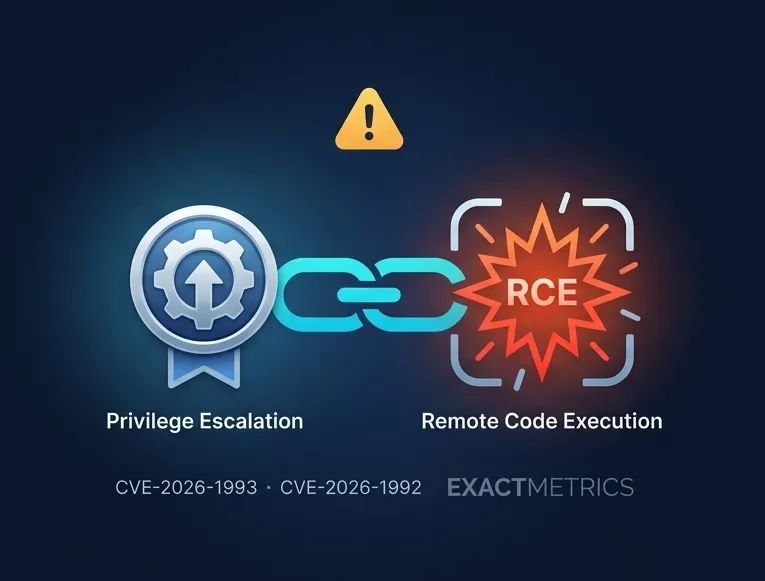
When two vulnerabilities share the same prerequisite capability in a WordPress plugin with over one million active installations, the security implications extend far beyond their individual CVSS scores. CVE-2026-1993 and CVE-2026-1992, both disclosed on March 10, 2026, affect ExactMetrics — the widely adopted Google Analytics Dashboard plugin for WordPress. Individually, each vulnerability carries a CVSS 8.8 High rating. But their true danger lies in how they chain together: CVE-2026-1993 provides improper privilege management that allows a low-privilege user to escalate their capabilities within the plugin, while CVE-2026-1992 exploits an Insecure Direct Object Reference to bypass authorization checks and install arbitrary plugins. Combined, an attacker with nothing more than analytics viewing permissions can achieve full Remote Code Execution on the WordPress server. This article dissects both vulnerabilities, demonstrates the chaining mechanism through code analysis and an animated attack flow diagram, and provides concrete remediation strategies for the estimated one million affected sites.
What Is ExactMetrics and Why It Matters
ExactMetrics (formerly Google Analytics Dashboard for WP, plugin slug google-analytics-dashboard-for-wp) is a WordPress plugin that simplifies Google Analytics integration. With over one million active installations according to the WordPress plugin directory, it ranks among the most deployed analytics solutions in the WordPress ecosystem. The plugin provides dashboard widgets, custom dimension tracking, eCommerce analytics integration, and enhanced link attribution — all managed through the WordPress admin panel.
What makes ExactMetrics architecturally significant from a security perspective is its custom capability model. Rather than relying solely on WordPress default roles such as Administrator, Editor, or Author, ExactMetrics introduces its own capability: exactmetrics_save_settings. This capability is designed to allow non-administrator users — marketing team members, analytics managers, SEO specialists — to view and modify analytics configuration without granting them full WordPress administrative access.
This delegation pattern is common among enterprise-grade plugins. A marketing director needs access to analytics settings but should not be able to install plugins, modify themes, or manage user accounts. The exactmetrics_save_settings capability serves this legitimate organizational need. However, the plugin's implementation of settings management functions introduced two critical flaws that violate the principle of least privilege, and when both flaws exist in the same plugin — accessible through the same low-privilege capability — they create a privilege escalation pipeline that transforms a marketing analytics account into a server-level compromise.
A common mistake developers make when building custom capability systems is treating the capability check as the sole security boundary. The capability confirms identity and role — it does not validate the action being performed. Functions protected by a single capability still need internal validation of what the caller is attempting to do.
CVE-2026-1993: Improper Privilege Management in update_settings()
The first vulnerability in the chain resides in the update_settings() function. This AJAX handler processes configuration changes submitted by users with the exactmetrics_save_settings capability. The function correctly verifies the nonce token and checks the required capability, but it fails at a critical step: it does not whitelist which settings can be modified.
The Vulnerable Pattern
Consider this simplified representation of the vulnerable logic:
// Simplified vulnerable update_settings() — no whitelist
function exactmetrics_ajax_update_settings() {
    check_ajax_referer( 'exactmetrics_save_settings' );

    if ( ! current_user_can( 'exactmetrics_save_settings' ) ) {
        wp_send_json_error( array( 'message' => 'Unauthorized' ) );
    }

    $settings = json_decode(
        wp_unslash( $_POST['settings'] ), true
    );

    // VULNERABLE: No whitelist — any setting key is accepted
    foreach ( $settings as $key => $value ) {
        exactmetrics_update_option( $key, $value );
    }

    wp_send_json_success();
}
The function iterates over all key-value pairs submitted in the POST request and writes them directly to the plugin's options storage. There is no validation of whether the setting key is one that the current user should be permitted to modify. This means a user with exactmetrics_save_settings can modify internal configuration values that control role assignments, addon management permissions, and even which users are considered plugin administrators.
Exploitation Mechanics
The exploitation path is straightforward. An attacker with the analytics viewing capability crafts a POST request that modifies internal role mapping settings:
POST /wp-admin/admin-ajax.php
action=exactmetrics_update_settings
&_wpnonce=<valid_nonce>
&settings={"users_can_manage":"all","admin_users":["attacker_id"]}
By changing the setting that maps WordPress roles to ExactMetrics administrative privileges, the attacker elevates their own account from a restricted analytics viewer to a full ExactMetrics administrator. This grants access to additional AJAX handlers and plugin management endpoints that were previously restricted.
The root cause is CWE-269: Improper Privilege Management. The function implicitly trusts that any user with exactmetrics_save_settings should be able to modify all settings, when in reality the capability was designed only for a subset of user-facing analytics configuration. The secure pattern is a settings whitelist — an explicit array of setting keys that non-administrative users are permitted to modify, with any unrecognized key rejected immediately.
The impact of this vulnerability alone is significant: privilege escalation within the plugin boundary. But the escalated privileges become the precise entry point for the second vulnerability, which extends the impact beyond ExactMetrics and into the WordPress core.
CVE-2026-1992: Authorization Bypass via IDOR in store_settings()
The second vulnerability targets the store_settings() function, which handles addon installation and configuration storage. Like update_settings(), it requires the exactmetrics_save_settings capability. But it introduces a far more dangerous flaw: an Insecure Direct Object Reference through the triggered_by parameter.
The IDOR Mechanism
// Simplified vulnerable store_settings() — IDOR via triggered_by
function exactmetrics_ajax_store_settings() {
    check_ajax_referer( 'exactmetrics_save_settings' );

    if ( ! current_user_can( 'exactmetrics_save_settings' ) ) {
        wp_send_json_error( array( 'message' => 'Unauthorized' ) );
    }

    // VULNERABLE: User-controlled key for authorization check
    $triggered_by = intval( $_POST['triggered_by'] );
    $user         = get_user_by( 'id', $triggered_by );

    // Authorization check runs against supplied user, NOT current user
    if ( $user && user_can( $user, 'install_plugins' ) ) {
        $addon_url = esc_url_raw( $_POST['addon_url'] );
        exactmetrics_install_addon( $addon_url );
    }

    wp_send_json_success();
}
The function accepts a triggered_by POST parameter that specifies a user ID. Instead of checking whether the current authenticated user has the install_plugins capability, it checks whether the user identified by triggered_by has that capability. This is a textbook IDOR: the authorization decision is made based on a user-controlled key rather than the authenticated session.
Why This Is Especially Dangerous
An attacker who knows or can guess an administrator's user ID — which is 1 in the vast majority of WordPress installations — submits a request with triggered_by=1. The function then checks if user ID 1 has the install_plugins capability, which any administrator does, and proceeds to install the specified addon URL. The attacker never needed install_plugins themselves.
This vulnerability is classified as CWE-639: Authorization Bypass Through User-Controlled Key. WordPress's user_can() function is being misused: it is designed as a utility to check capabilities for arbitrary users in contexts like administrative dashboards, not as the sole authorization gate for privileged operations on the current request. The correct function is current_user_can(), which always checks the authenticated session.
The capability escalation through IDOR is particularly dangerous because it crosses the boundary from plugin permissions into WordPress core permissions. The install_plugins capability allows downloading and activating arbitrary WordPress plugins from any URL — including attacker-controlled servers hosting malicious plugins containing PHP webshells.
Developers frequently make this mistake when building multi-step workflows: they pass user context through form parameters or hidden fields rather than re-verifying the current user at each step. The secure pattern is to always use current_user_can() for authorization decisions and never rely on user-supplied identifiers.
The Attack Chain: From Settings Viewer to RCE
When combined, CVE-2026-1993 and CVE-2026-1992 form a four-step attack chain that escalates from a low-privilege analytics capability to full Remote Code Execution:
- Initial Access: The attacker authenticates with a WordPress account that has the
exactmetrics_save_settingscapability — typically a marketing team member or analytics manager. - Privilege Escalation (CVE-2026-1993): The attacker sends a crafted POST request to the
update_settings()AJAX handler, modifying internal role mappings and addon management settings. This elevates their ExactMetrics role to full plugin administrator, granting access to additional endpoints. - Authorization Bypass (CVE-2026-1992): With the elevated plugin role, the attacker targets the
store_settings()function. They settriggered_by=1(the default administrator user ID), bypassing theinstall_pluginscapability check. They supply a malicious addon URL pointing to an attacker-controlled server. - Remote Code Execution: WordPress downloads and installs the malicious plugin, which contains a PHP webshell. The attacker now has arbitrary code execution on the server with the privileges of the web server process.
The chaining mechanism is what transforms two individually high-severity vulnerabilities into a critical attack path. CVE-2026-1993 alone provides privilege escalation within ExactMetrics but cannot escape the plugin boundary. CVE-2026-1992 alone requires elevated plugin permissions and knowledge of the internal IDOR pattern. Together, each vulnerability enables the next, creating a clean escalation path that any attacker with basic WordPress knowledge can execute.
From a CVSS perspective, both vulnerabilities are rated 8.8 High with identical vectors (AV:N/AC:L/PR:L/UI:N/S:U/C:H/I:H/A:H). But the chained impact — full RCE from a low-privilege account — arguably warrants a combined critical assessment. This is a scalability concern for vulnerability management programs: CVSS scores treat vulnerabilities in isolation, but attackers do not.
Affected Versions and Patch Matrix
Both vulnerabilities were patched in version 9.0.3, released alongside the disclosure on March 10, 2026. However, their affected version ranges differ significantly:
| Field | CVE-2026-1993 | CVE-2026-1992 |
|---|---|---|
| CWE | CWE-269 Improper Privilege Management | CWE-639 Auth Bypass via User-Controlled Key |
| CVSS Score | 8.8 High | 8.8 High |
| Affected Versions | 7.1.0 – 9.0.2 | 8.6.0 – 9.0.2 |
| Patched Version | 9.0.3+ | 9.0.3+ |
| Attack Vector | Network (authenticated) | Network (authenticated) |
| Researcher | Ali Sünbül | Ali Sünbül |
| Assigner | Wordfence | Wordfence |
The version range difference is notable. CVE-2026-1993 affects versions from 7.1.0 onward, suggesting the update_settings() function without a whitelist has existed since early versions of the plugin. CVE-2026-1992 has a narrower range starting at 8.6.0, indicating the store_settings() function with the IDOR was introduced in a later feature update.
This means sites running versions between 7.1.0 and 8.5.x are vulnerable to the privilege escalation component only, while sites running 8.6.0 through 9.0.2 are vulnerable to the complete attack chain. Both CVEs were reserved on February 5, 2026, disclosed on March 10, and published on March 11.
Real-World Architecture Scenario: Marketing Team Compromise
Consider a mid-sized eCommerce company running WooCommerce with ExactMetrics for conversion tracking and funnel analysis. The marketing team of five people has been granted the exactmetrics_save_settings capability so they can configure Google Analytics goals, custom dimensions, and eCommerce tracking parameters without requiring IT involvement for every analytics change.
One morning, a targeted phishing email reaches the marketing team lead. The attacker has crafted a convincing Google Analytics notification clone — a common social engineering pattern in this sector. The team lead clicks the link and enters their WordPress credentials. With this single compromised account, the attacker executes the full chain:
- Minutes 0–2: The attacker enumerates ExactMetrics settings through the plugin's AJAX endpoints, identifying the internal configuration keys.
- Minutes 2–5: Using CVE-2026-1993, they modify role mappings to elevate their plugin permissions, gaining access to addon management functions.
- Minutes 5–10: They exploit CVE-2026-1992 with
triggered_by=1to install a minimal PHP webshell disguised as a legitimate analytics addon. - Minutes 10+: The webshell provides server access. The attacker reads
wp-config.php(exposing database credentials), accesses customer data, injects payment skimmers into WooCommerce templates, and establishes persistence through WordPress cron jobs.
The entire attack completes before the marketing team lead has reported the suspicious email. The initial compromise of a single marketing account has cascaded into a full infrastructure breach. On shared hosting environments, the impact extends beyond the single site — the PHP process may have read access to adjacent sites on the same server.
Mitigation and Remediation
For site administrators, the immediate priority is clear:
- Update ExactMetrics to version 9.0.3 or later immediately. This single action patches both vulnerabilities.
- Audit capability assignments: Review which users have the
exactmetrics_save_settingscapability. Remove it from accounts that do not actively require analytics configuration access. - Check for suspicious plugins: Inspect the
wp-content/pluginsdirectory for any recently installed plugins that were not authorized by the site administrator. - Review AJAX logs: Check server access logs for POST requests to
admin-ajax.phpwithaction=exactmetrics_update_settingsoraction=exactmetrics_store_settingsfrom unexpected IP addresses. - Rotate credentials: If you suspect exploitation, change the WordPress admin passwords and regenerate the security salts in
wp-config.php.
For WordPress plugin developers, these vulnerabilities illustrate two defensive patterns that should be non-negotiable:
- Settings whitelists: Every settings update function must validate the submitted keys against an explicit whitelist. The whitelist should be a hardcoded array, not derived from database configuration that an attacker could modify.
- Use
current_user_can(), neveruser_can()with user-supplied IDs: Authorization decisions must always operate on the authenticated session context, never on user-controlled parameters. If you need to perform actions on behalf of another user, implement a dedicated impersonation system with audit logging.
For security teams managing WordPress fleets, implement file integrity monitoring for the wp-content/plugins directory and deploy WAF rules that inspect POST parameters in WordPress AJAX requests for known exploitation patterns.
Frequently Asked Questions
Do both CVEs require authentication to exploit?
Yes. Both vulnerabilities require the attacker to be authenticated with a WordPress account that has the exactmetrics_save_settings capability. However, this is a low-privilege capability commonly granted to marketing and analytics team members, making it a realistic attack prerequisite. The attacker does not need WordPress administrator access to begin the chain.
What is the effective severity when both CVEs are chained together?
Individually, each CVE is rated CVSS 8.8 High. When chained, the combined impact escalates to Remote Code Execution from a low-privilege account, which functionally represents a critical-severity attack path. CVSS does not provide a formal mechanism for scoring vulnerability chains, which is why organizations should supplement CVSS with contextual risk analysis that considers chaining potential.
Which ExactMetrics versions are vulnerable to the full attack chain?
The complete chain (privilege escalation followed by IDOR to RCE) is exploitable on versions 8.6.0 through 9.0.2. Versions 7.1.0 through 8.5.x are only vulnerable to CVE-2026-1993 (privilege escalation within the plugin), as the IDOR in store_settings() was introduced in version 8.6.0. All affected versions should be updated to 9.0.3 or later.
How can I detect if my site was compromised through these vulnerabilities?
Check for unauthorized plugins in the wp-content/plugins directory, particularly any installed after the disclosure date that you did not authorize. Review your server access logs for POST requests to admin-ajax.php containing exactmetrics_update_settings or exactmetrics_store_settings actions. Look for PHP files with obfuscated code or base64-encoded payloads in the plugins directory. If you find evidence of compromise, treat it as a full server breach and follow your incident response procedures.
Conclusion
CVE-2026-1993 and CVE-2026-1992 are a stark reminder that CVSS scores do not tell the full story. Individually rated 8.8 High, together they create a critical attack chain that enables Remote Code Execution from a low-privilege analytics account on over one million WordPress sites. The attack requires no user interaction beyond authentication, leverages the default administrator user ID present in virtually all WordPress installations, and can be executed in under ten minutes.
For WordPress administrators, the action is immediate: update ExactMetrics to 9.0.3 and audit your capability assignments. For the broader development community, these vulnerabilities illustrate two security principles that are frequently violated: settings functions must validate what is being changed, not just who is changing it, and authorization checks must always operate on the authenticated user context, never on user-supplied identifiers. Vulnerability chaining is not a theoretical concern — it is the operational reality of how attackers exploit modern applications. Design your security boundaries with the assumption that adjacent vulnerabilities exist and will be found. Explore our cybersecurity archive for more deep-dive analyses on how vulnerability patterns recur across plugins, frameworks, and platforms.
Tags
Share this post
Subscribe
Get the latest posts delivered right to your inbox.



Leave a comment