Cybersecurity
Umbraco CMS Security Alert: Three Critical Vulnerabilities Patched in Versions 16.5.1 and 17.2.2
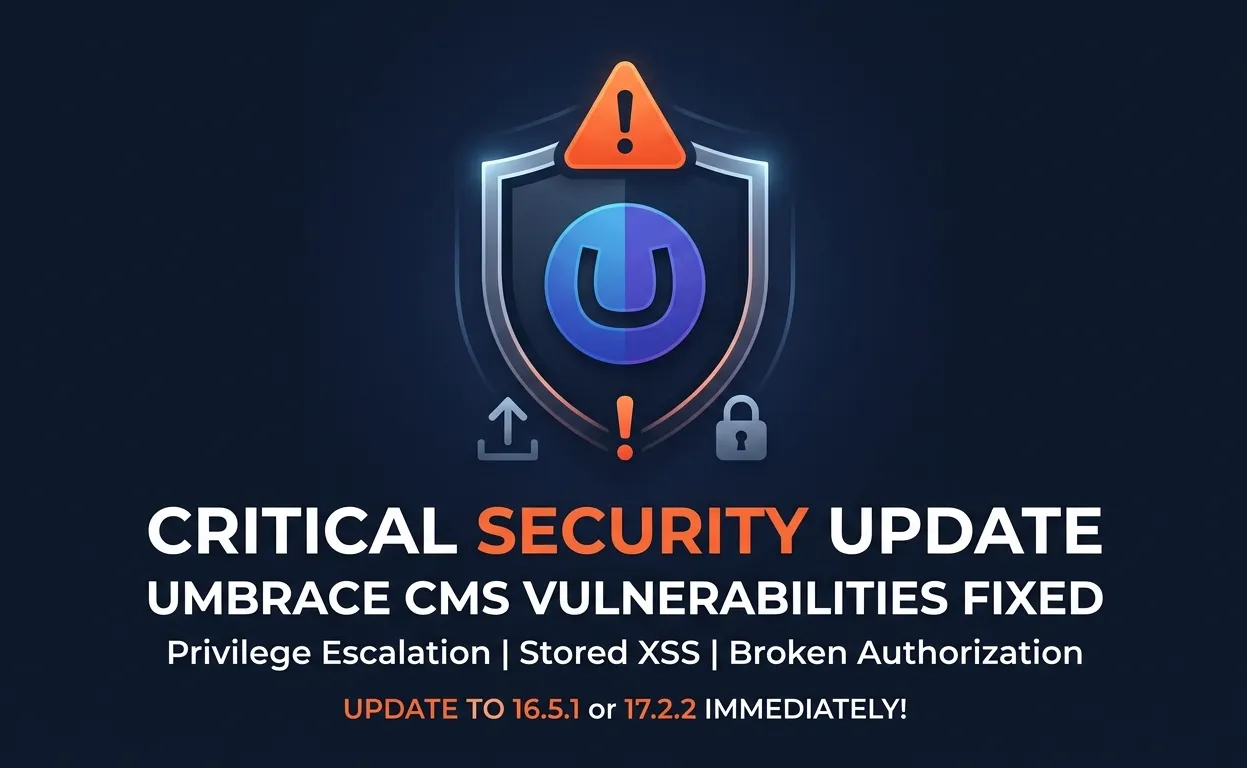
Umbraco, one of the most widely adopted open-source content management systems built on the ASP.NET ecosystem, has released an urgent security advisory addressing three distinct vulnerabilities in its backoffice management interface. The vulnerabilities, tracked as CVE-2026-31834, CVE-2026-31833, and CVE-2026-31832, collectively impact a wide range of Umbraco versions dating back to version 14.0.0 and are resolved in the newly released versions 16.5.1 and 17.2.2. While all three flaws require authenticated backoffice access to exploit, their combined severity poses a significant risk to organizations running unpatched instances. A compromised backoffice user account — even one with limited privileges — could potentially chain these vulnerabilities to escalate access, inject persistent malicious scripts, and manipulate content across the entire CMS. Administrators running Umbraco in production environments should treat this advisory with high priority and plan their upgrade path immediately.
What Happened: Umbraco Security Advisory Overview
In March 2026, the Umbraco security team disclosed three vulnerabilities affecting the CMS backoffice — the administrative panel used by content editors, administrators, and developers to manage website content, users, and settings. All three vulnerabilities share a common prerequisite: the attacker must have valid authenticated access to the Umbraco backoffice. However, this does not diminish their severity, as many organizations grant backoffice access to multiple team members, contractors, or third-party agencies with varying levels of trust.
The three vulnerabilities span different categories from the OWASP Top 10, including Broken Access Control (A01:2021) and Injection (A03:2021), making this a multi-vector security event that requires immediate attention from both system administrators and security teams.
Immediate Action Required
If your Umbraco instance runs any version between 14.0.0 and 16.5.0, or between 17.0.0 and 17.2.1, you are affected by at least one of these vulnerabilities. The recommended action is to upgrade immediately to either version 16.5.1 or 17.2.2, depending on your current major version track.
Affected Versions and Patch Matrix
Understanding which versions are affected is critical for prioritizing your response. The following table provides a clear mapping of each CVE to its affected version range and the corresponding fix:
| CVE ID | Vulnerability Type | Affected From | Fixed In | OWASP Category |
|---|---|---|---|---|
| CVE-2026-31834 | Privilege Escalation | 15.3.1 | 16.5.1 / 17.2.2 | A01 — Broken Access Control |
| CVE-2026-31833 | Stored XSS (HTML Injection) | 16.2.0 | 16.5.1 / 17.2.2 | A03 — Injection |
| CVE-2026-31832 | Broken Object-Level Authorization | 14.0.0 | 16.5.1 / 17.2.2 | A01 — Broken Access Control |
Notice that CVE-2026-31832 has the widest impact window, affecting all versions from 14.0.0 onward. This means organizations that have not upgraded since the 14.x release cycle are exposed to at least this BOLA vulnerability. If you are running versions in the 15.3.1+ range, you are potentially exposed to two or all three of these flaws simultaneously.
From an infrastructure planning perspective, the breadth of affected versions means that many production Umbraco deployments — particularly those in enterprise environments with conservative upgrade cycles — are likely vulnerable right now. The longer an organization delays the upgrade, the wider the exposure window becomes.
Technical Breakdown of Each Vulnerability
For security professionals and developers responsible for maintaining Umbraco installations, understanding the technical root cause of each vulnerability is essential for both remediation and forensic analysis. Below is a detailed examination of each CVE.
CVE-2026-31834 — Privilege Escalation via User Group Membership Manipulation
This vulnerability resides in the user management functionality of the Umbraco backoffice. Specifically, when an authenticated user with permissions to manage other users modifies user group memberships, the system fails to enforce proper authorization checks on which groups can be assigned.
In a correctly implemented role-based access control (RBAC) system, a user should only be able to assign roles that are at or below their own privilege level. The vulnerable code path does not validate whether the requesting user has sufficient privileges to assign highly privileged roles such as the Administrator group. This means a user with only "User Manager" permissions could potentially assign themselves or another account to the Administrator group, effectively achieving full system control.
The practical impact is severe: an attacker with even a low-privilege backoffice account that includes user management capabilities could escalate to full administrative access. In environments where content editors are given user management rights for workflow purposes, this creates a direct path to complete CMS compromise.
A common mistake in CMS deployments is granting user management permissions too broadly. Many Umbraco administrators assign user management rights to team leads or senior editors as a convenience feature, without considering that these permissions, combined with a vulnerability like CVE-2026-31834, effectively grant those accounts the ability to become full administrators. The principle of least privilege is not optional — it is a critical defense layer that limits the blast radius of authorization bypass vulnerabilities.
CVE-2026-31833 — Stored XSS Through DOMPurify Bypass in Property Type Descriptions
This vulnerability exploits a misconfiguration in the DOMPurify sanitization library used by Umbraco's frontend framework (UFM). The root cause is an overly permissive attributeNameCheck configuration set to the regex pattern /.+/, which effectively matches any attribute name and bypasses attribute-level filtering entirely.
Under normal circumstances, DOMPurify strips dangerous HTML attributes such as onclick, onload, onerror, and similar event handlers. However, when these event handler attributes are used within Umbraco-specific web components (elements prefixed with umb-*, uui-*, or ufm-*), the permissive regex allows them to pass through sanitization unfiltered.
An attacker with access to the Settings section of the Umbraco backoffice can inject malicious HTML into property type descriptions. Since these descriptions are rendered across the backoffice whenever the property type is used, the injected script executes in the context of every backoffice user who views a content node using that property type. This makes it a stored (persistent) XSS attack with potentially wide-reaching impact within the organization.
The technical insight here is particularly important for developers building custom web components: custom element prefixes can create blind spots in sanitization libraries. When DOMPurify or similar tools are configured to allow arbitrary attributes on custom elements, it defeats the purpose of attribute-level sanitization. This is a pattern that extends beyond Umbraco — any application using web components with overly permissive sanitizer configurations is susceptible to similar bypass techniques.
CVE-2026-31832 — Broken Object-Level Authorization in Domain Assignment API
The third vulnerability is a classic Broken Object-Level Authorization (BOLA) flaw, ranked as one of the most common API security issues by the OWASP API Security Top 10. The vulnerability exists in a backoffice API endpoint responsible for assigning domains to content nodes.
In Umbraco's content architecture, content nodes represent individual pages or content items, and domains can be assigned to them for multi-site or multilingual configurations. The vulnerable API endpoint does not properly verify whether the authenticated user has permission to access the target content node before allowing domain assignment operations.
This means an authenticated backoffice user can manipulate API requests to assign or modify domain-related data on content nodes that fall outside their permitted scope — whether restricted by user group privileges or start node configurations. In practice, a content editor with access to only a specific section of the content tree could modify domain settings on the root node or on nodes belonging to entirely different sites in a multi-tenant setup.
The impact in multi-tenant Umbraco deployments is particularly concerning. Organizations that host multiple websites or brand properties on a single Umbraco instance rely on start node restrictions to isolate tenant access. This vulnerability undermines that isolation, potentially allowing cross-tenant domain manipulation that could lead to domain hijacking, SEO poisoning, or phishing setups.
Real-World Attack Scenario: Chaining the Three Vulnerabilities
While each vulnerability is dangerous on its own, the real threat emerges when considering how an attacker could chain all three CVEs in a coordinated attack. Consider the following scenario in a mid-size organization running Umbraco 16.4.x with multiple backoffice users:
- Initial Access: The attacker compromises a low-privilege content editor account — perhaps through credential stuffing, phishing, or by being a malicious insider with limited permissions.
- Domain Manipulation (CVE-2026-31832): Using the BOLA vulnerability, the attacker calls the domain assignment API to map a phishing domain to the organization's main content node, potentially redirecting traffic or setting up convincing phishing pages.
- Persistent Backdoor (CVE-2026-31833): The attacker injects malicious JavaScript into a commonly used property type description. This script could exfiltrate session tokens, capture keystrokes, or silently perform actions on behalf of any administrator who views content in the backoffice.
- Privilege Escalation (CVE-2026-31834): With captured administrator credentials or session tokens from the XSS payload, the attacker uses the privilege escalation flaw to permanently elevate their own account to the Administrator group, ensuring persistent full access even if the XSS payload is later discovered and removed.
This chain demonstrates why treating these vulnerabilities in isolation significantly underestimates the actual risk. A well-executed attack using all three CVEs could result in complete CMS takeover with persistent access — all originating from a single compromised low-privilege account.
Scalability and Performance Considerations During Remediation
For organizations running Umbraco in large-scale or high-availability configurations, the upgrade path requires careful planning. Upgrading from versions as old as 14.x to 16.5.1 or 17.2.2 is not a trivial operation, especially in environments with:
- Custom backoffice extensions or plugins that depend on specific API versions
- Load-balanced deployments with multiple Umbraco nodes sharing a database
- CI/CD pipelines that need updated build configurations
- Custom user group configurations that should be audited post-upgrade
- Content Delivery Networks (CDN) with cached backoffice assets that need invalidation
While the security patches themselves are targeted fixes, organizations on significantly older versions may need to plan a staged migration. In such cases, implementing the interim mitigations described below becomes critical to reduce exposure while the upgrade is being prepared. The key is to balance operational continuity with security urgency — prioritize internet-facing production instances first, then move to staging and internal environments.
Immediate Mitigation Steps
Whether you can upgrade immediately or need time to plan your migration, the following steps should be executed as soon as possible:
- Upgrade to patched versions: Update to Umbraco 16.5.1 or 17.2.2 depending on your current version track. This is the only definitive fix for all three vulnerabilities.
- Audit user group memberships: Review all backoffice user accounts and their group assignments. Look for any unexpected privilege escalations, particularly accounts recently added to the Administrator group.
- Review property type descriptions: Inspect all property type descriptions in the Settings section for any injected HTML or JavaScript code. Pay special attention to any content containing event handler attributes like
onclickoronload. - Check domain assignments: Verify that domain mappings on content nodes match expected configurations. Look for any unauthorized or unfamiliar domain bindings, especially on high-traffic nodes.
- Enable backoffice access logging: If not already active, enable detailed audit logging for all backoffice operations, particularly user management actions and API calls to domain-related endpoints.
- Restrict user management permissions: As an interim measure, revoke user management permissions from all non-administrator accounts until the upgrade is complete.
- Implement network-level restrictions: Restrict backoffice access to trusted IP ranges or VPN connections to reduce the attack surface while the patch is applied.
Frequently Asked Questions
Can these vulnerabilities be exploited by anonymous users?
No. All three CVEs require authenticated access to the Umbraco backoffice. An attacker must possess valid credentials for a backoffice user account to exploit any of these vulnerabilities. However, this does not eliminate the risk — compromised credentials, malicious insiders, or accounts shared with external contractors all represent viable attack vectors that should not be underestimated.
Is my site vulnerable if I only use Umbraco as a headless CMS?
Yes. These vulnerabilities affect the backoffice API and management interface, which are present regardless of whether you use Umbraco in headless mode or with traditional server-rendered views. If your Umbraco backoffice is accessible and you are running an affected version, you are vulnerable. The delivery mechanism of your frontend does not change the exposure of the backoffice layer.
Can I patch individual CVEs without a full version upgrade?
Umbraco has not released individual patches for these vulnerabilities. The fixes are included in the 16.5.1 and 17.2.2 releases. A full version upgrade within your current major version track is the recommended remediation path. Attempting to backport fixes manually is not recommended due to the risk of introducing regressions.
How can I verify if my instance has been compromised?
Review your Umbraco audit logs for unusual user group modifications, check property type descriptions for injected HTML content, and verify domain assignments across all content nodes. If you suspect compromise, perform a thorough security audit including database-level inspection of user records and content metadata. Look specifically for recently modified user group memberships and property type descriptions that contain script tags or event handler attributes.
Are Umbraco Cloud customers automatically patched?
Umbraco Cloud managed instances typically receive updates on a managed schedule. Contact Umbraco HQ support to confirm whether your Cloud instance has been patched, and request expedited updates if it has not. Do not assume automatic patching has occurred without verification.
Protecting Your Umbraco Investment
The disclosure of CVE-2026-31834, CVE-2026-31833, and CVE-2026-31832 serves as a critical reminder that authenticated-only vulnerabilities are not low-risk vulnerabilities. In enterprise environments where dozens of users access the CMS backoffice daily, the attack surface is significantly larger than many administrators assume. The combination of privilege escalation, persistent XSS, and broken authorization checks creates a threat landscape where a single compromised account can cascade into full system takeover.
Take action today: audit your current Umbraco version, review your user permission model, and plan your upgrade to 16.5.1 or 17.2.2. If you manage multiple Umbraco instances across different environments, prioritize production systems that are internet-facing and have the largest number of backoffice users. Security patching is not optional — it is the most cost-effective investment in protecting your digital infrastructure.
Tags
Share this post
Subscribe
Get the latest posts delivered right to your inbox.

Leave a comment