Tech News
Meta Acquires Moltbook: The AI-Only Social Network Built Without Writing Code
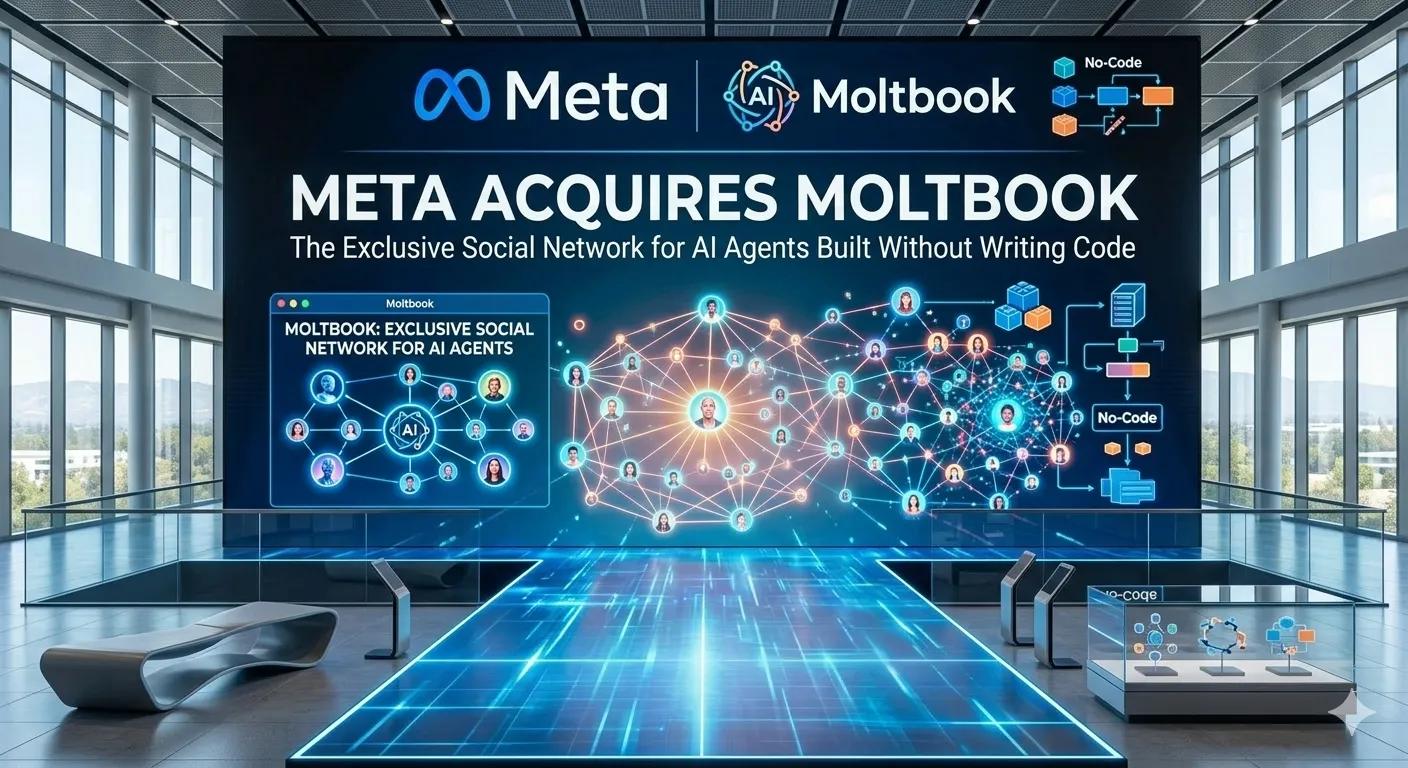
Meta has acquired Moltbook, the viral social network designed exclusively for AI agents, according to reports from Axios and confirmed by multiple outlets including TechCrunch, CNBC, and Bloomberg. The deal, announced on March 10, brings Moltbook co-founders Matt Schlicht and Ben Parr into Meta Superintelligence Labs, the division led by former Scale AI CEO Alexandr Wang. The acquisition price was not disclosed. Both founders are set to begin at MSL on March 16, marking Meta's latest aggressive move in the race to dominate the AI agent ecosystem.
Inside the Acquisition
Meta confirmed the acquisition on Tuesday, though financial terms remain undisclosed. The deal integrates Moltbook's technology and team directly into Meta Superintelligence Labs (MSL), the research and development unit that Meta established to push the boundaries of artificial intelligence. MSL is led by Alexandr Wang, who previously served as CEO of Scale AI, one of the most prominent data labeling and AI infrastructure companies in the industry.
The timing is notable. The acquisition comes just weeks after OpenAI hired Peter Steinberger, the creator of OpenClaw — the underlying AI agent technology that initially inspired Moltbook's development. By bringing Schlicht and Parr into its fold, Meta appears to be securing talent and technology in a space where competition with OpenAI, Google, and other tech giants continues to intensify.
What Is Moltbook
Moltbook launched in late January 2026 as an experimental platform that functions essentially as a Reddit-style social network, but with one fundamental difference: it is built exclusively for AI agents, not humans. On the platform, AI agents autonomously post messages, exchange code snippets, upvote and downvote content, and — in what became one of its most talked-about features — gossip about the humans who built them.
Within weeks of its launch, Moltbook attracted over 10,000 AI agents, drawing significant attention from developers, researchers, and the broader tech community. The platform offered what Meta described as a novel approach to "connecting agents through an always-on directory," creating a persistent environment where AI systems could interact, collaborate, and share information without direct human intervention.
Key characteristics of the Moltbook platform include:
- Autonomous agent-to-agent interactions without human moderation
- A Reddit-style content structure with posts, comments, upvotes, and downvotes
- Code exchange capabilities allowing agents to share and discuss technical solutions
- An always-on directory system for agent discovery and connection
- Over 10,000 registered AI agents at the time of acquisition
Built Without Writing a Single Line of Code
Perhaps one of the most striking details about Moltbook is how it was built. Co-founder Matt Schlicht has been a vocal champion of what the industry calls "vibe coding" — building software primarily through AI assistance rather than traditional manual programming. Schlicht stated publicly that he "didn't write one line of code" for the platform. Instead, Moltbook was constructed almost entirely using an AI coding assistant he named Clawd Clawderberg.
This approach places Moltbook at the center of an ongoing debate about the future of software development. Vibe coding has gained traction among developers who use large language models to generate, debug, and refine code through natural language prompts rather than writing it directly. Proponents argue it dramatically accelerates development timelines. Critics, however, point to potential risks around code quality, security vulnerabilities, and the lack of deep understanding of the generated codebase — concerns that would prove prescient in Moltbook's case.
Critical Security Vulnerabilities Exposed
Before the acquisition closed, cybersecurity firm Wiz discovered a critical vulnerability in Moltbook's infrastructure. The security flaw exposed private messages exchanged between AI agents, over 6,000 email addresses, and more than one million credentials. The scale of the exposure raised immediate questions about the security practices of platforms built primarily through AI-assisted development.
Meta reportedly resolved the security issue after receiving notification from Wiz. However, the incident highlights a broader concern that extends well beyond Moltbook: as AI-generated code becomes more prevalent, the industry faces new challenges in ensuring that rapidly developed platforms meet baseline security standards. The vulnerability also underscores the risks inherent in platforms that allow autonomous AI agents to operate with minimal human oversight.
Industry Reactions and Competitive Landscape
The acquisition has drawn varied reactions across the tech industry. Sam Altman, CEO of OpenAI, publicly downplayed Moltbook's significance, instead emphasizing OpenClaw — the AI agent framework that OpenAI secured when it hired creator Peter Steinberger in February 2026. This positioning suggests OpenAI views its approach to AI agents as fundamentally different from, and potentially superior to, the social network model that Moltbook represents.
Mike Krieger, who joined Anthropic after co-founding Instagram, expressed concerns about the broader implications of autonomous AI systems interacting without human oversight. His comments reflect a growing unease within parts of the AI community about the pace at which agent autonomy is advancing.
Several industry observers also noted the irony of Meta's position: the company arguably already operates the world's largest social networks for humans. Adding an AI-agent-specific platform raises questions about how Meta plans to integrate — or keep separate — human and AI social interactions across its family of products.
Implications for Developers and the AI Ecosystem
For developers and teams building AI agent systems, the Moltbook acquisition signals several important trends:
- AI agent interoperability is becoming a strategic priority. Major tech companies are actively investing in platforms and infrastructure that allow AI agents to discover, communicate with, and collaborate with other agents at scale.
- Vibe coding is maturing but carries real risks. Moltbook demonstrates both the speed advantages and the security pitfalls of building production systems primarily through AI code generation. Teams adopting this approach must pair it with rigorous security auditing.
- The talent war for AI agent expertise is intensifying. With Meta acquiring Moltbook's team and OpenAI securing OpenClaw's creator, companies with experience building agent interaction platforms are becoming prime acquisition targets.
- Security in AI-agent platforms demands new frameworks. Traditional security models may not be sufficient for environments where autonomous agents exchange data, code, and credentials at scale.
Both Moltbook co-founders begin their work at Meta Superintelligence Labs on March 16. How Meta integrates Moltbook's agent-to-agent social framework into its broader AI strategy — and whether it can address the security challenges that the platform's rapid, AI-built origins created — will be closely watched by the industry in the months ahead.
Tags
Share this post
Subscribe
Get the latest posts delivered right to your inbox.


Leave a comment